As 5-axis machining becomes more common across precision manufacturing, many shops are discovering that success in multi-axis work depends on more than the machine alone. A high-end machining center may offer exceptional movement, advanced control, and the ability to reach complex part surfaces from multiple angles, but those advantages only matter if the workpiece is held in the right way. Without proper workholding, even the most capable 5-axis machine can struggle to deliver stable, repeatable, and efficient results.
This is why more manufacturers are moving away from general-purpose clamping methods and investing in specialized workholding designed specifically for multi-axis machining. In a 3-axis environment, a standard vise may be sufficient for many jobs. In 5-axis machining, however, the demands are different. Shops need better access, more consistent positioning, fewer setup changes, and stronger control over how the workpiece is presented to the cutting tool.
That is where a dedicated 5 axis vise becomes an important part of the process.
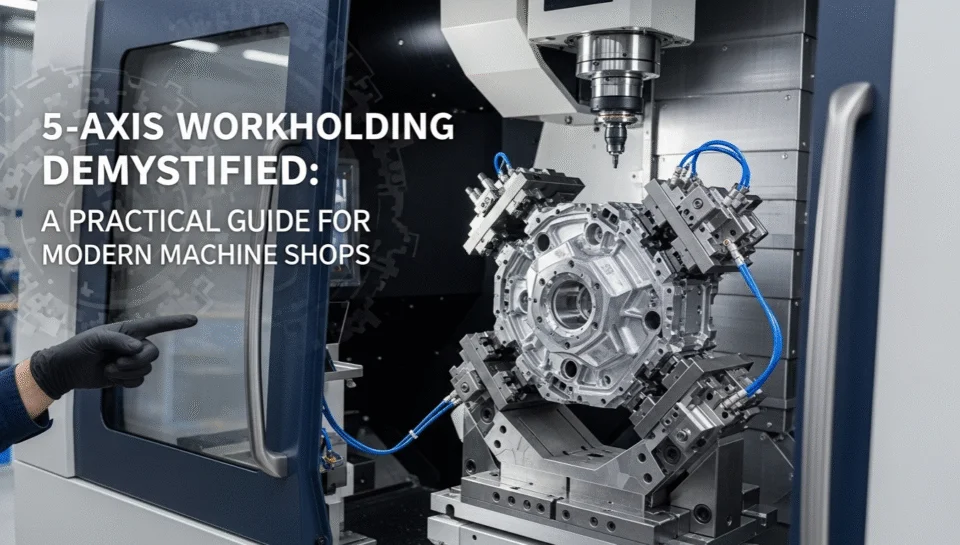
Why General-Purpose Clamping Creates Limits in 5-Axis Work
Traditional vises are often designed for straightforward top-access machining. They do the basic job of holding material securely, but they are not always ideal when a part must be reached from multiple sides in one setup. In fact, the vise body itself can easily become an obstacle. It may block spindle access, reduce usable machining angles, or require the part to be repositioned several times before all features can be completed.
Every extra setup creates a new opportunity for error. Once the part is removed and clamped again, there is always a risk of losing orientation, changing the reference position, or introducing small variations that affect the final dimensions. In a precision environment, those small variations can become expensive problems.
This is one of the biggest reasons why general-purpose clamping is often a poor fit for 5-axis work. It may appear more affordable at first, but it can cost far more in the form of longer setup time, lower consistency, and limited use of machine capability.
Better Access Is One of the Biggest Benefits
The value of 5-axis machining comes largely from access. Shops invest in this technology because it allows the cutting tool to approach a part from more directions and complete more features in fewer operations. But if the workholding system blocks that access, much of the benefit is lost.
A dedicated 5 axis vise is built with this challenge in mind. Instead of surrounding the workpiece with unnecessary bulk, it helps expose more of the part so the spindle can reach critical surfaces with less interference. That makes it easier to machine complex geometries in a single setup and reduces the need for repeated clamping adjustments.
For shops producing aerospace parts, medical components, molds, and other precision workpieces, this improved access can make a major difference. It not only saves time, but also helps protect dimensional accuracy by reducing repositioning steps.
Specialized Workholding Supports Better Repeatability
Another major requirement in 5-axis machining is repeatability. Complex parts often involve tight tolerances and multiple features that must align correctly across different surfaces. If the workpiece is not positioned consistently, the machine cannot produce those features as accurately as intended.
Specialized workholding helps solve this issue by providing more controlled and repeatable positioning. In many cases, self-centering designs are especially useful because they help locate the part evenly and predictably. This reduces setup variation and makes it easier for machinists to reproduce the same result from one part to the next.
Repeatability matters not only for accuracy, but also for productivity. When operators trust the setup, they spend less time indicating parts, adjusting offsets, or checking alignment. Over time, that creates a smoother workflow and better output across the shop floor.
A Better Match for Modern Production Demands
Today’s manufacturing environment is more demanding than ever. Shops are expected to produce more complex parts with tighter tolerances and shorter lead times, often while handling smaller batches and more frequent changeovers. Under these conditions, outdated workholding methods quickly become a bottleneck.
Specialized workholding is better suited to this reality because it is designed to support modern machining strategies. It helps reduce setup time, supports more reliable part positioning, and allows the machine to perform more of the job in one clamping cycle. This kind of efficiency is no longer a bonus. For many shops, it is necessary to stay competitive.
At the same time, it is also important to evaluate the broader range of cnc vise options available from a supplier. Different jobs demand different clamping styles, jaw capacities, and setup strategies. A supplier that offers more than one type of vise gives manufacturers more flexibility to match the workholding solution to the actual machining requirement.
Why the Right Vise Improves More Than Just Holding Power
It is easy to think of a vise as a tool that only provides clamping force. In reality, the right vise supports multiple aspects of the machining process at the same time. It influences accessibility, repeatability, setup speed, operator confidence, and even process stability under aggressive cutting conditions.
This is why choosing a cnc vise should never be treated as a simple hardware decision. In advanced machining, the vise is part of the process design. The more closely it aligns with the needs of the job, the better the machine can perform.
For 5-axis shops in particular, this is especially important. The machine’s flexibility is only valuable if the workholding system allows that flexibility to be used effectively. A specialized solution helps unlock the full benefit of multi-axis machining instead of forcing the machine to work around unnecessary limitations.
Conclusion
5-axis machining is not just a more advanced version of standard CNC work. It places different demands on setup, positioning, and tool access, which means it also requires a different approach to workholding. General-purpose clamping may still have a place in some jobs, but for precision multi-axis work, specialized support is often the smarter choice.
A dedicated workholding solution can reduce setup changes, improve part access, increase repeatability, and help shops get more value from their machines. In a competitive machining environment, those advantages matter.
In the end, successful 5-axis machining is not only about what the machine can do. It is also about whether the part is being held in a way that allows the machine to do it well.
