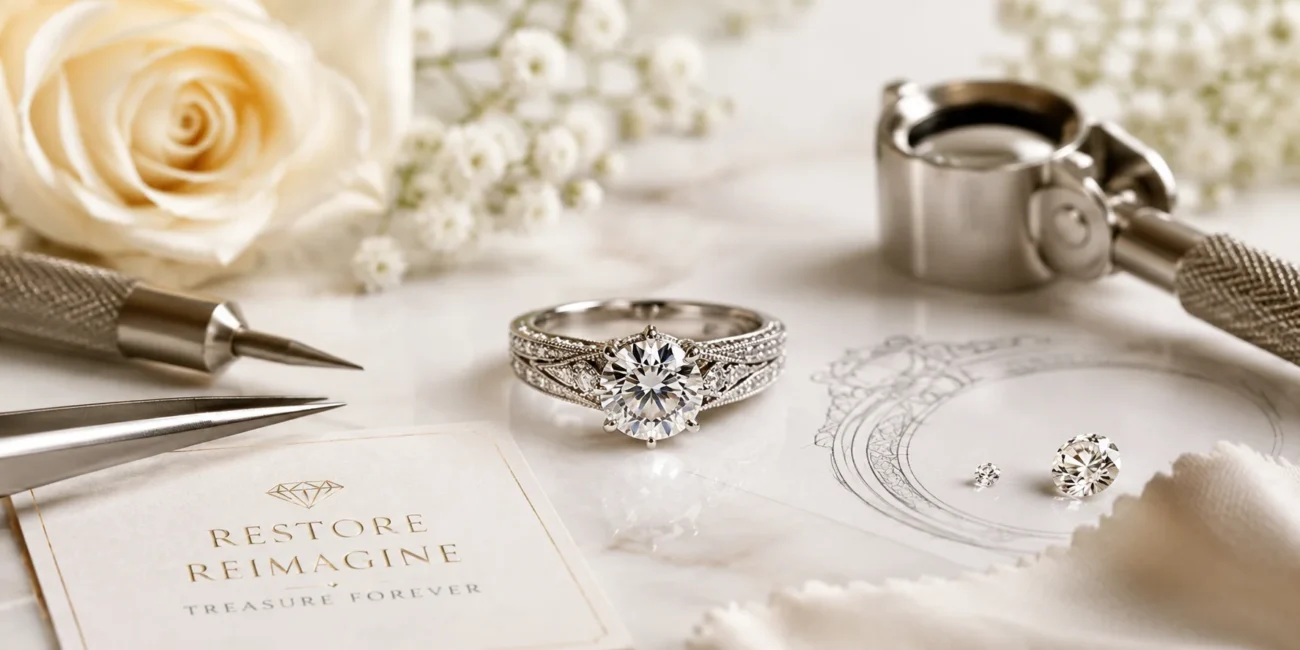
Put two laboratory-grown diamonds beside each other and you might prefer the one with a lower grade in one category. Perhaps its shape reads more clearly or it shows a pattern of light you find more appealing. The report helps explain what you are seeing, but one number rarely settles the choice. Give each grade a job in the comparison before paying for an improvement.
Among the decisions when choosing a lab-grown diamond engagement ring, cut, colour, clarity and carat weight help answer different questions. Use the report to confirm what a seller is describing and compare the individual stones under the same light before making a decision.
Begin with the cut and what you can see
Check whether the report provides an overall cut assessment for the shape you are considering. Reports differ in scope and terminology. Where there is no overall grade, look at the measurements and finish information, and ask to see how the stone handles light. A pair of diamonds in the same shape may show very different patterns even when their dimensions are close.
Compare the stones in diffuse light and tilt them slowly. Notice which stays interesting from several angles and which has areas that draw your eye for the wrong reason. If you are comparing elongated stones, look across the middle as well as at the tips. A good face-up impression is worth more to many wearers than small differences in characteristics they cannot detect.
Compare colour and clarity in context
Try two nearby colour grades against the metal you intend to use. Small differences may be easier to see when the stones are viewed loose, side by side. Check again with the stone facing upwards, the way you are likely to see it most often. A pale tint can be less prominent in some settings and more evident beside small white side stones.
For clarity, ask to see where any inclusions are and what they look like at normal distance. A small feature near the side may be hard to see, while one near the centre can be easier to notice. If an inclusion lies near an edge, ask whether it affects how the jeweller would mount the diamond. That question has more bearing on the purchase than a general preference for a higher grade.
Use carat weight alongside dimensions
Compare millimetres so you know how much space the stone will occupy. If one weighs more and appears very similar from above, decide whether the difference serves a purpose for you. A smaller stone with a pleasing outline can leave more of the budget for a setting that suits your hand.
Check the issuing laboratory’s report terminology and confirm that the paperwork corresponds to the diamond you are considering. Ask whether any treatment is recorded and how it is described. Once you know both stones meet your requirements, compare full quotes in the same setting. That gives you a clearer idea of what the grade differences cost.
Final Thought
Prioritise the differences you can see or that affect the setting. Use the grading information to understand them, and let the stones themselves decide whether an upgrade is worth paying for.
