Your Series A is closed. The board wants pipeline numbers that justify the raise. You have one or two paid channels working, but scaling them linearly means rising costs and diminishing returns. A multichannel advertising strategy is the only way to grow spend without watching CAC climb alongside it.
Here is how growth-stage startups build a multichannel approach that compounds instead of collapses.
The Single-Channel Trap
Most startups hit a wall with their first channel between $30,000 and $80,000 in monthly spend. Google Search CPCs creep up as you exhaust high-intent keywords. Meta frequency scores climb as your audience sees the same ads for the third time. The channel still works, but the marginal return on each new dollar drops.
The instinct is to “optimize harder.” Better landing pages. More creative variants. Tighter audiences. These help, but they are incremental gains against a structural ceiling. The platform has a finite pool of your ideal buyers. No amount of optimization changes that.
Scaling one channel is addition. Scaling multiple channels is multiplication.
What a Real Multichannel Strategy Requires
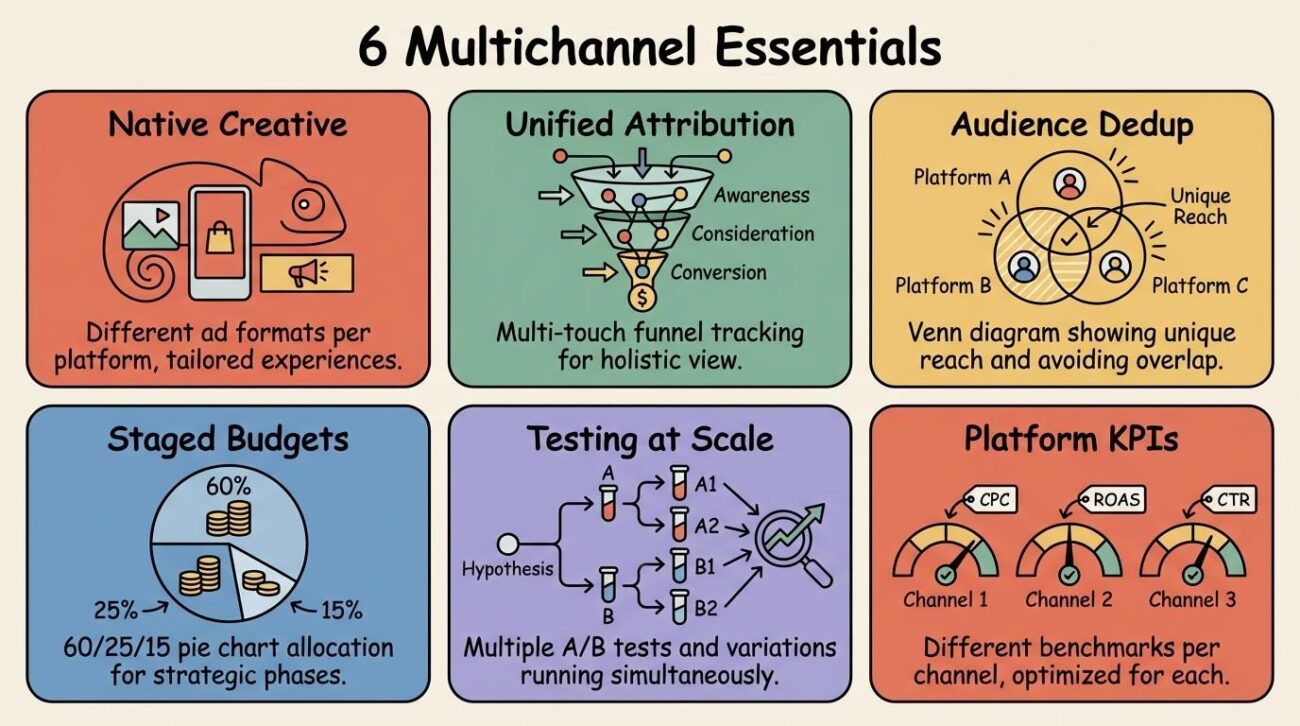
Channel-Specific Creative, Not Recycled Assets
Each platform has its own culture and format. A LinkedIn ad repurposed as a Reddit promoted post will underperform. A Meta video ad slapped into a YouTube pre-roll wastes money. Multichannel does not mean multi-platform with the same creative. It means native execution on every platform.
Unified Attribution Across Channels
When you run ads on four platforms, you need to know which one influenced the deal. Multi-touch attribution models that weight first-touch, last-touch, and mid-funnel assists give you the real picture. Without this, you will over-credit the last channel and under-credit the one that started the conversation.
Audience Deduplication
If your Google, Meta, and LinkedIn campaigns all target the same 50,000 people, you are running one channel with three invoices. Strong multichannel strategies seek incremental reach. Each new channel should add audience segments the others do not cover. Community platforms like Reddit reach users who actively avoid traditional ad networks, making them a natural addition to the mix. When you advertise on reddit, you tap into technical and niche audiences that rarely overlap with your Meta or LinkedIn segments.
Staged Budget Allocation
Do not split budget evenly across all channels on day one. Start with 60% on your proven channel, 25% on a secondary channel with early signal, and 15% on a pure experiment. Shift allocation quarterly based on blended CAC per channel.
A/B Testing Infrastructure That Scales
Running creative tests across four channels means managing dozens of experiments simultaneously. You need a system, not a spreadsheet. Track hypothesis, variant, platform, audience, and result in a structured way. The teams that test fastest learn fastest.
Platform-Specific KPIs
CTR benchmarks on Reddit are different from Meta. CPC norms on LinkedIn are different from Google. Holding every channel to the same KPI standard penalizes platforms with different user behavior. Set channel-specific benchmarks and measure each platform against its own potential.
Building Your Multichannel Stack This Quarter
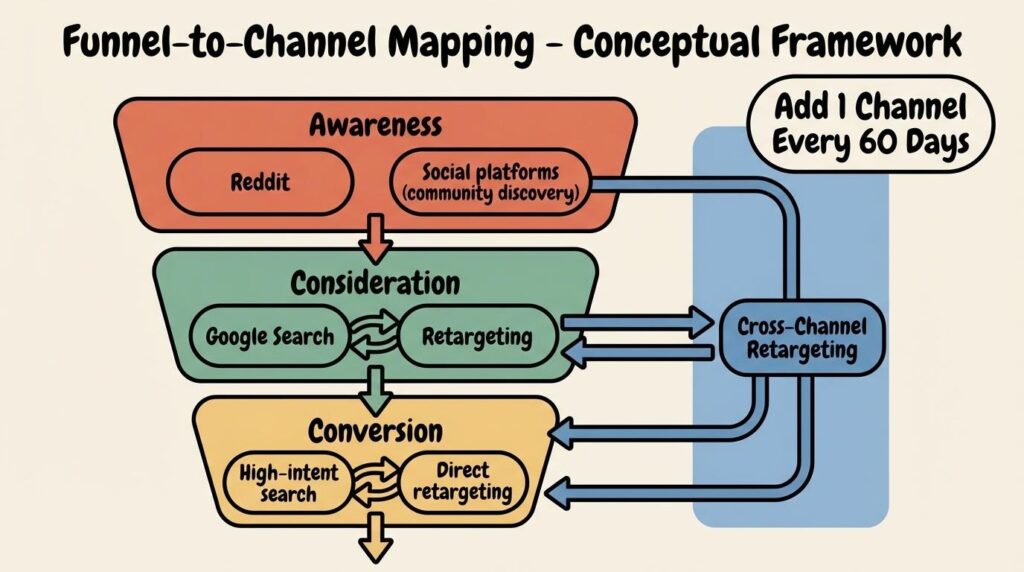
Map your funnel to your channels. Top-of-funnel awareness works well on community and social platforms. Mid-funnel consideration fits search and retargeting. Bottom-funnel conversion favors high-intent channels. Assign each channel a funnel role.
Add one new channel every 60 days. Moving too fast dilutes focus. Moving too slowly lets competitors claim the audience first. A 60-day cadence gives you time to learn, optimize, and decide before stacking the next channel.
Use community platforms for top-of-funnel discovery. Platforms where users discuss problems organically are ideal for introducing your brand. When you advertise on reddit, you reach people in research mode, which makes it a strong awareness channel that feeds your retargeting pools across other platforms.
Run cross-channel retargeting. A user who clicks a Reddit ad but does not convert can be retargeted on Meta or Google. This creates a surround-sound effect where your brand appears across their browsing experience.
Report on blended metrics monthly. Individual channel CAC matters for optimization. Blended CAC across all channels is what the board cares about. If your blended CAC drops as you add channels, your strategy is working.
The Compounding Advantage
Startups running three or more channels see something that single-channel companies do not: compounding awareness. A prospect sees your brand in a subreddit, then in a Google result, then in a Meta retargeting ad. Each touchpoint reinforces the last.
This halo effect is invisible in single-channel attribution but obvious in pipeline growth. Companies with multichannel strategies report 20-30% lower blended CAC compared to single-channel peers at the same spend level.
Your competitors will figure this out eventually. The advantage goes to whoever builds the multichannel engine first.
