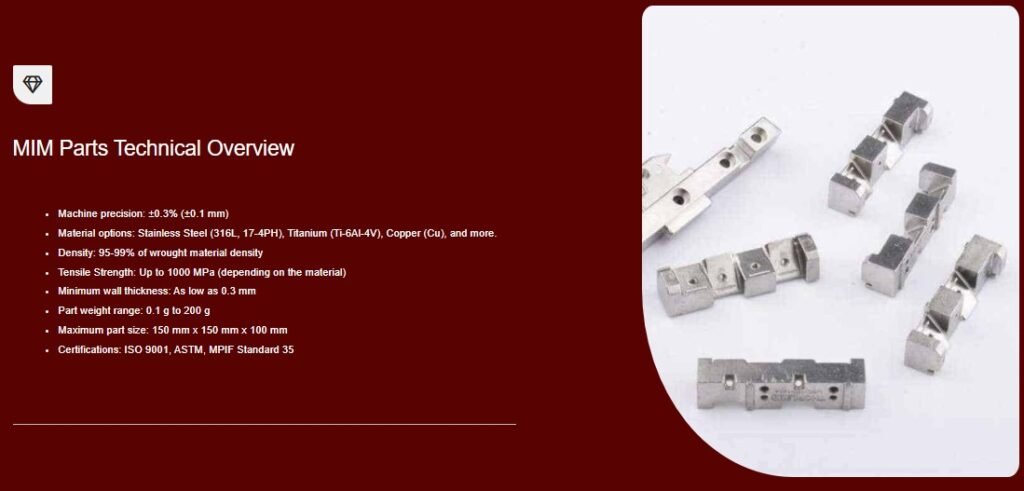
Metal Injection Molding, commonly known as MIM, has revolutionized the manufacturing industry by offering a cost-effective and precise method for producing complex metal components. MIM parts are increasingly popular across multiple sectors, from medical devices to automotive components, due to their strength, precision, and versatility. This guide will walk you through everything you need to know about MIM parts, including their manufacturing process, benefits, applications, materials, and design considerations.
Understanding MIM Parts
MIM parts are created using a combination of powdered metals and a binding agent, which allows manufacturers to mold intricate shapes that would be challenging to produce using traditional machining techniques. The process starts with the mixing of fine metal powders with a polymer binder, forming a feedstock. This feedstock is then injected into a mold under high pressure, similar to plastic injection molding. After molding, the parts undergo a debinding process to remove the binder, followed by sintering, where heat fuses the metal particles into a solid, dense component.
The result is a highly detailed, dimensionally accurate metal part that requires minimal post-processing. This capability makes MIM parts an ideal solution for industries that demand precision and repeatability in high-volume production.
Benefits of Using MIM Parts
One of the main reasons MIM parts have gained popularity is the combination of cost efficiency and performance. Compared to traditional machining, MIM allows for the production of complex geometries without extensive material waste. Since the parts are molded rather than machined, manufacturers can achieve intricate designs that would otherwise be impossible or expensive to create.
Additionally, MIM parts offer high strength and durability. The sintering process ensures that the parts maintain excellent mechanical properties, often comparable to wrought metals. They also provide consistent quality, tight tolerances, and smooth surface finishes, which reduces the need for additional finishing operations. For industries like medical, aerospace, and electronics, where precision is critical, these characteristics are invaluable.
MIM parts also enable lightweighting opportunities. By optimizing the design and using advanced alloys, manufacturers can produce components that are strong yet lighter than their traditionally manufactured counterparts. This is particularly important in the automotive and aerospace industries, where reducing weight can improve efficiency and performance.
Materials Commonly Used for MIM Parts
MIM parts can be produced from a wide variety of metals, each offering unique properties suitable for different applications. Stainless steel is one of the most commonly used materials due to its corrosion resistance, strength, and versatility. It is ideal for medical instruments, consumer electronics, and automotive components.
Other materials include titanium, which is valued for its high strength-to-weight ratio and biocompatibility, making it perfect for medical implants and aerospace components. Nickel-based alloys and cobalt-chrome are used in applications requiring extreme wear resistance and durability, such as dental implants and engine parts. Even soft metals like copper and aluminum can be processed using MIM, providing options for electrical components and heat exchangers.
Selecting the right material is crucial because it directly impacts the performance, cost, and manufacturability of the MIM parts. Manufacturers often collaborate with clients to evaluate material requirements and determine the optimal choice for their specific application.
Design Considerations for MIM Parts
While MIM parts offer tremendous design freedom, certain factors must be considered to ensure successful production. One key aspect is wall thickness. Uniform wall thickness helps minimize defects such as warping or sink marks during molding and sintering. Extremely thin or thick walls may require design adjustments or support features.
Draft angles are another critical factor. Including slight tapers in the mold design facilitates the removal of the part without damaging intricate features. Complex geometries like undercuts and deep cavities may require additional tooling considerations or assembly techniques.
Designers should also account for shrinkage during the sintering process. MIM parts typically shrink by about 15-20% from the molded size, depending on the material. Accurate prediction and compensation for this shrinkage are essential to achieve precise final dimensions.
Surface finish is another area where MIM parts excel, but it still requires attention during the design phase. Polishing, coating, or secondary machining may be needed depending on the application. Understanding these factors early in the design process ensures efficient production and reduces the risk of costly modifications.
Applications of MIM Parts
The versatility of MIM parts allows them to be used in a wide range of industries. In the medical sector, MIM parts are widely used for surgical instruments, implants, and dental components due to their precision, biocompatibility, and corrosion resistance. Complex geometries that are difficult to machine make MIM an ideal solution for these applications.
The automotive industry also benefits significantly from MIM technology. Small, intricate components like gears, brackets, and valve parts can be produced in high volumes at a lower cost compared to traditional methods. MIM parts help reduce weight and improve fuel efficiency without compromising strength.
In consumer electronics, MIM parts are used in connectors, housings, and micro-mechanical components. The precision and repeatability of MIM make it ideal for compact devices where space is limited. Aerospace applications also rely on MIM parts for small, lightweight components that can withstand extreme temperatures and stress.
Other industries such as firearms, industrial machinery, and renewable energy also leverage MIM technology for parts that require strength, durability, and complex designs. The flexibility of MIM parts continues to open new opportunities across emerging technologies.
Quality Control and Inspection
Quality control is a critical aspect of producing MIM parts. Dimensional accuracy, mechanical properties, and surface finish must all meet strict industry standards. Manufacturers employ a range of inspection methods, including coordinate measuring machines (CMM), optical scanners, and metallographic analysis, to ensure that every part meets specifications.
Process control during molding, debinding, and sintering is equally important. Consistency in temperature, pressure, and timing directly affects the final quality of the MIM parts. Advanced manufacturers often use statistical process control (SPC) to monitor production and maintain high standards.
Cost Considerations
MIM parts are cost-effective for high-volume production due to their ability to minimize material waste and reduce secondary operations. However, initial tooling costs for molds can be high, which makes low-volume production less economical. When considering MIM parts, businesses must evaluate production volume, material choice, and design complexity to determine the overall cost-effectiveness.
Despite the upfront investment, MIM parts often offer long-term savings through reduced labor, less material waste, and faster production cycles. For components that are difficult or impossible to machine efficiently, MIM is often the most practical and economical solution.
Future of MIM Parts
The future of MIM parts looks promising as technology continues to advance. Innovations in powder metallurgy, binder systems, and sintering techniques are expanding the range of materials and applications. Additive manufacturing combined with MIM is also opening new possibilities for hybrid production methods, allowing even more complex designs and rapid prototyping.
Sustainability is another factor driving the growth of MIM technology. By minimizing material waste and energy consumption compared to traditional machining, MIM aligns with the global push toward greener manufacturing practices. As industries continue to demand lightweight, strong, and intricate metal components, MIM parts are poised to play an increasingly important role.
Conclusion
MIM parts represent a powerful solution for manufacturing complex metal components with precision, efficiency, and versatility. From medical devices to automotive parts, electronics, and aerospace applications, MIM technology offers a unique combination of cost-effectiveness, high strength, and design freedom. By understanding the materials, design considerations, production process, and quality control measures, businesses can leverage MIM parts to create innovative solutions that meet the demands of modern industries.
As the technology continues to evolve, MIM parts will only become more capable
